










Expo highlights major advancements in consumer technology

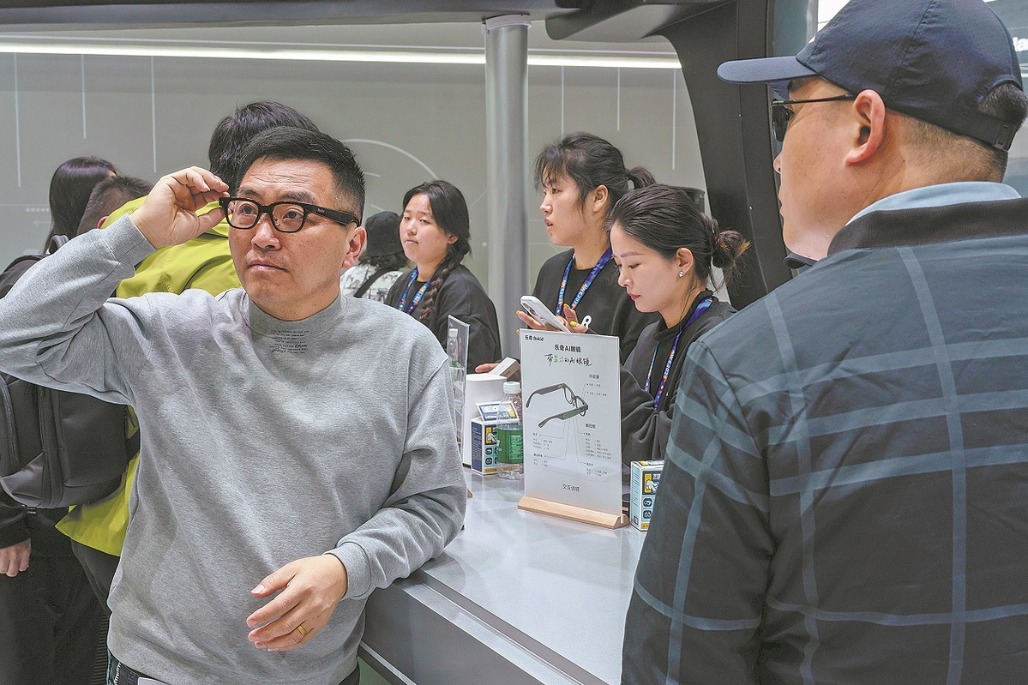
Visitors will be able to try out Rokid AI glasses with built-in displays at AWE 2026 in Shanghai on March 13. Chen Li/For China Daily
Becoming an important window in the development of China’s consumer electronics industry, the Appliances & Electronics World Expo 2026 in March this year was marked by the deep integration of artificial intelligence across the sector, officials and experts said.
Spread across 170,000 square meters of exhibition space, this year’s AWE showcased thousands of cutting-edge technologies and smart lifestyle solutions to delegates.
“The exhibition presents a panoramic view of the achievements made in areas including intelligent terminals, smart mobility, health technology, embedded intelligence and computing infrastructure, showcasing the latest progress of high-quality development within China’s home appliance and consumer electronics industry,” said Tao Xiaonian, president of the China Home Appliances Association.
Tao said, “As this year’s theme ‘Smart AI, Smarter Future’ indicates, AI has deeply integrated into the entire industry. With AI, home appliances are able to make continuous upgrades in functional design, active services, multi-device scenario connectivity, and human-computer interaction.”
According to Tao, advances in innovative display technologies are blurring the boundaries between the digital world and reality.
For example, smartphones and smart glasses are rapidly emerging as the next generation of personal intelligent devices. Meanwhile, humanoid robots are moving toward commercial applications at an accelerated pace.
As an important part of the lighting industry, the home appliance sector has achieved impressive results, with retail sales of home appliances expected to exceed 1.1 trillion yuan ($159.92 billion) in 2025 and reach a record high, according to Zhang Chonghe, chairman of the China National Light Industry Council.
“The penetration rate of digital devices in research, development and design has exceeded 85 percent, which is well above the average level of other industries, making this sector a benchmark for high-end, intelligent and green development in the lighting industry,” Zhang said.
The event also launched a special committee on household service robots under the supervision of China Household Electrical Appliances Association, marking a new stage in ecosystem development for companies in the industry chain.
“The committee addressed common challenges faced by the industry, including repetitive data collection, inconsistent technical pathways and lack of standards,” said Wan Chunhui, deputy secretary-general of the China Household Electrical Appliances Association.
According to Wan, more than 50 companies joined the first batch of committee members, covering the entire home robotics industry chain, including home appliances, embedded intelligence, companion robots, AI models, AI motion control, chips, new materials and batteries.
“Leading home appliance companies are not only playing a leading role in developing home robot products tailored to specific home needs, but also providing solutions that upgrade individual smart products into carriers of integrated intelligent services,” Zhang said.
According to him, robots for specific scenarios – such as elder care, cleaning and companionship – are experiencing rapid growth.
“China is currently the largest robot market globally, producing 55 percent of the world’s robots. Last year, the country produced 18.58 million service robots, an increase of 16.1 percent year-on-year,” Zhang said.
Under the guidance of the central government to boost domestic demand, the consumer electronics industry is entering a new stage of development, as rapid growth in the sector is blurring the boundaries between online and offline consumption, said Yao Yao, head of research at JLL China.
“In Shanghai, the share of newly opened consumer electronics store space among lifestyle stores increased from 21 percent in 2023 to 26 percent in 2025. Leading brands are accelerating their expansion of brick-and-mortar stores, creating technology consumption channels such as immersive experiences and scenario-based marketing, reshaping the relationship between consumers and technology products, and effectively increasing in-store consumption,” Yao said. Said.
For the first time since its establishment in 1992, the event established two venues this year, with a combined exhibition space of 170,000 square meters.
It included a 140,000 square meter exhibition area at the Shanghai New International Expo Center and a newly launched 30,000 square meter space at the Shanghai Eastern Hub International Business Cooperation Zone.